

You’ve finished your film. Now you need a trailer for your press kit, to catch distributor attention at markets, or to build buzz on social media before your festival premiere.
But here’s the problem: a trailer isn’t a recap—it’s a sales tool.
The difference between a general video editor and a trailer specialist is like comparing a photographer to a marketing copywriter. Both work with images, but only one knows how to sell.
The wrong platform choice costs you more than money. You lose weeks to revisions, compromise on pacing, or settle for generic cuts that fail to hook distributors or festival programmers scrolling through hundreds of submissions.
Before outsourcing, ask: Does this platform understand trailer craft, or just video editing?
What to Evaluate Before Choosing a Platform
Not all platforms are built for the same workflow. Before comparing options, know what matters:
- Specialization in film trailers — Does the editor understand three-act compression and emotional beats?
- Revision speed & iteration workflow — Can you pivot quickly based on festival deadlines or sales agent feedback?
- Pricing transparency — Do you know exactly what you’re paying upfront?
- Communication friction — How many steps between you and creative execution?
- Creative control — Are you directing the vision or hoping the editor “gets it”?
- Scalability — One trailer or ongoing catalog needs?
These criteria separate platforms that host editors from platforms that solve the trailer problem.
Platform #1: Fiverr (Marketplace Model)
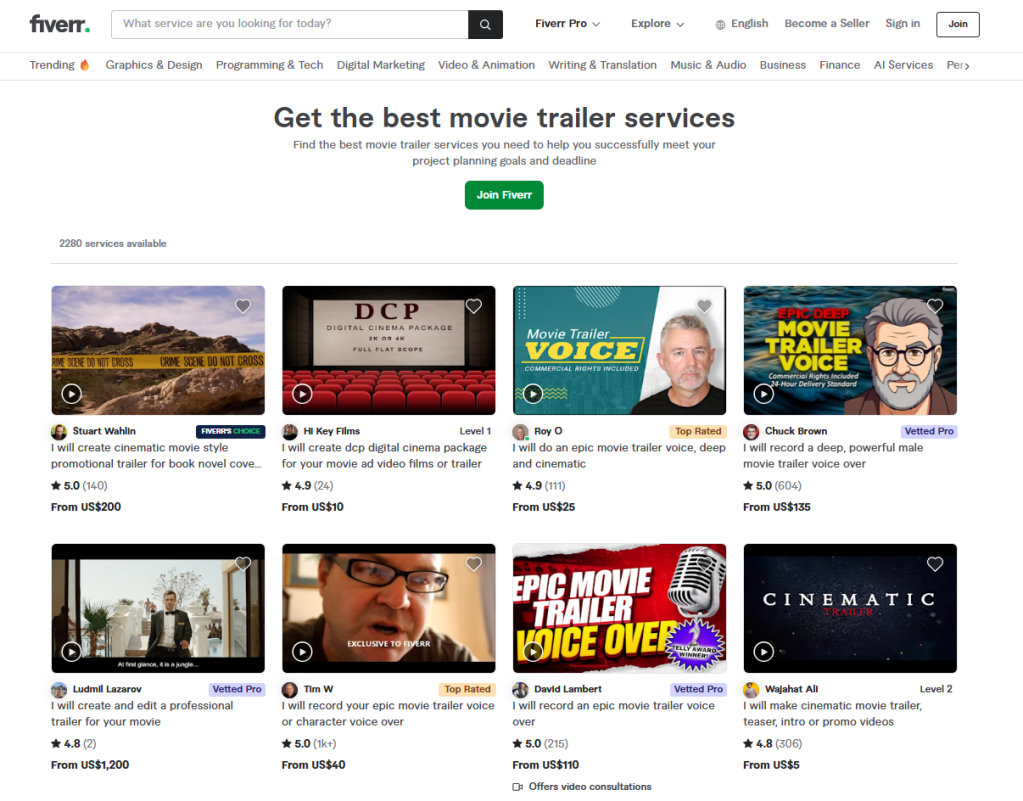
How it works: Browse gigs, order a package, communicate through Fiverr’s messaging system.
Strengths:
- Budget entry point (gigs start at $50–$150)
- Large pool of global editors
- Fast to initiate a project
Weaknesses:
- Quality variance is extreme (no trailer specialization filter)
- Revision limits baked into pricing tiers
- Messaging delays through platform intermediary
- Most editors treat trailers like highlight reels
Best for:
- Micro-budget projects testing multiple creative directions
- Experimental or proof-of-concept work where speed matters more than precision
Strategic reality: Fiverr is a volume marketplace optimized for one-off tasks, not iterative creative partnerships.
Platform #2: Upwork (Bidding Model)
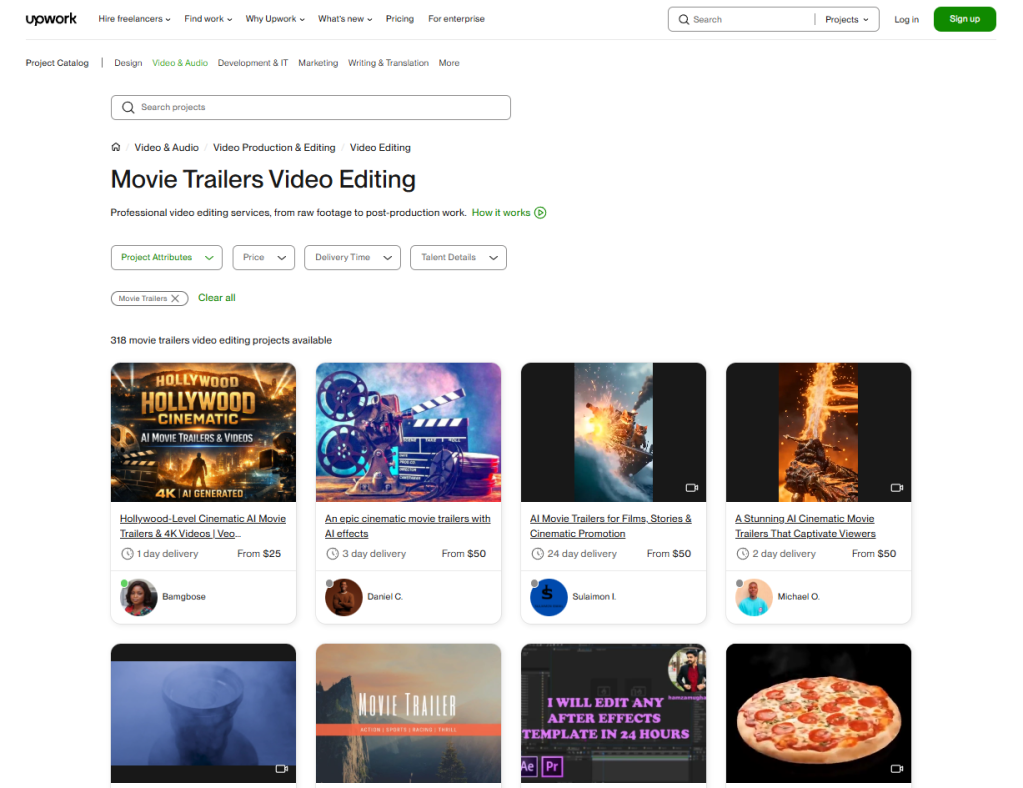
How it works: Post a job description, review proposals, negotiate terms, hire.
Strengths:
- Access to more experienced freelancers
- Custom contract terms
- Portfolio vetting before commitment
Weaknesses:
- Time-intensive selection process (screening 20+ proposals is common)
- Requires filmmaker to define scope precisely
- No trailer-specific vetting or expertise markers
- Overhead: platform fees + negotiation friction
Best for:
- Producers managing multiple freelancers across roles
- Longer editorial relationships (series of trailers, ongoing post-production)
Strategic reality: Upwork gives you control but demands project management skill. It’s a hiring tool, not a specialized service.
The Volume Problem: When Your Trailer Is Just Another Task
Here’s what most filmmakers miss about marketplace platforms: the editors aren’t optimizing for your success—they’re optimizing for throughput.
A Fiverr or Upwork freelancer juggling 10–15 projects simultaneously has one priority: close your project and move to the next one. They’re not thinking about whether your trailer will stop a festival programmer mid-scroll or convince a distributor to watch your feature. They’re thinking about delivering something acceptable enough to avoid revisions.
This isn’t a criticism of their work ethic—it’s the economic reality of volume-based freelancing. When your revenue depends on completing as many gigs as possible, you can’t afford to obsess over the emotional beat that makes a buyer lean forward.
If your trailer needs to sell—not just exist—you need a different model.
Platform #3: MAX-Q (Specialized Remote Trailer Editing)
How it works: You send your film. I cut your trailer. You review and iterate within 48 hours.
This isn’t a marketplace—it’s a dedicated trailer editing service.
Positioning:
- 100% focused on film trailers (not corporate videos, not wedding highlights)
- Direct collaboration model (no bidding, no platform intermediary)
- Remote-first infrastructure built for fast iteration
Strengths:
- Trailer specialization: I only cut trailers. Every project leverages learned craft in narrative compression and emotional pacing.
- 48-hour review cycles: Send notes, get revisions. No scheduling friction.
- Afordable pricing: Averages of $450 for a 2-minute trailer.
- Direct communication: You work with an editor, not a platform support system.
- Structured alignment process: I extract your vision upfront so iteration refines, not restarts.
Ideal for:
- Indie directors needing festival or pitch trailers
- Sales agents building catalog materials
- Projects requiring controlled pacing and narrative precision
Strategic reality: MAX-Q trades marketplace breadth for trailer depth. You’re not hiring an editor—you’re partnering with a trailer specialist.
Sample trailer created by me for The Hitman’s Dalliance press kit:
Platform Comparison
| Criteria | Fiverr | Upwork | MAX-Q |
| Specialization | General video editing | General freelance | Film trailers only |
| Avg. Turnaround | 5–10 days | 7–14 days | 48-hour reviews |
| Pricing Model | Tiered gig packages | Hourly or fixed bid | $450/2 min average rate |
| Revision Structure | Limited by tier | Negotiated per contract | Unlimited within scope |
| Best For | Budget testing | Managing freelancers | Trailer-focused iteration |
Decision Guide: Choose Based on Your Situation
If you want the lowest entry price and are willing to screen editors yourself:
If you want to post a job and manage the hiring process yourself:
If you want a trailer specialist with fast iteration and zero marketplace friction:
Looking for a Dedicated Film Trailer for Marketing?
MAX-Q eliminates the platform layer. You send your film, I cut your trailer, you iterate directly with me.
 MAX-Q Studio