
Your Film Is Finished. Now What?
You spent months — maybe years — making your film. Now it’s done, and you’re staring at a blank distribution plan wondering: where do I even start?
Everyone says “make a trailer.” But no one tells you where to put it, how to time it, or what actually moves the needle between a film that builds an audience and one that gets forgotten the week it drops.
That’s what this article is about.
What I See From the Editing Room
As a trailer editor working with independent filmmakers on festival submissions and releases, I’ve watched the same thing kill promising projects at the finish line: not lack of talent, not lack of budget — but paralysis. A wall of platforms, conflicting advice, and no clear starting point.
After working across dozens of releases, I started noticing a pattern. The films that built an audience — even with zero theatrical budget — did three specific things, always in the same order.
The One Thing You Need to Understand
There is no single platform where your audience lives.
The filmmakers who win aren’t on the best platform — they’re everywhere their viewer already is. Your trailer is the one asset that makes that possible across all of them.
The Three-Part Pattern That Works
Here’s the framework consistently applied across independent releases:
- Build your main trailer
- Promote it through social media
- Release through a free distribution channel
Simple. But the execution — and the sequencing — is everything.
Let me show you exactly how it works with a real example.
Step 1: Build Your Main Trailer
Independent director Boris Steele came to us with RED-X — his upcoming short based on the DC Comics character. He was still in late post-production, which meant we were cutting a trailer from an unfinished film. That’s not unusual. In fact, it’s smart:
your trailer should be in motion before your film is locked.
Boris’s goal was clear: create buzz on social media before release. So we didn’t approach the trailer as a summary of the film — we designed it as a marketing asset, built on sales and attention principles. Cuts, pace and every sound choice was made to stop a scroll and create anticipation.
The trailer needed to work on its own, without context, for a viewer who had never heard of Boris or the project. That’s the standard every trailer should be held to.
Step 2: Promote It Through Social Media
Here’s what most filmmakers miss: Boris didn’t start building his audience after the trailer was done. He started months earlier.
Through his personal Instagram, he had already been sharing work from his previous films — building a base of followers who trusted his craft before RED-X ever appeared. By the time the trailer launched, he wasn’t shouting into a void. He was releasing into a community that was already warm.
Two weeks before the film’s release date, he dropped the trailer and opened the RED-X presence across his channels.
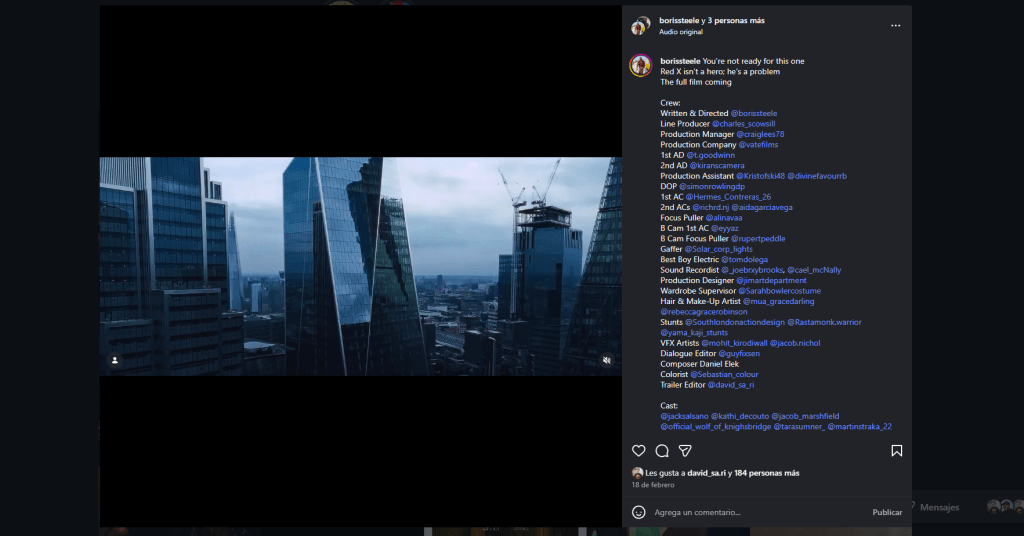
Social media distribution for an independent film costs nothing but time. That’s the point. You don’t need a marketing budget — you need consistency and timing.
Step 3: Release Through a Free Distribution Channel
Two weeks after the trailer went live, Boris released RED-X on YouTube and made a second Instagram post directing his audience there.
The result: 13,000 views.
To put that in perspective — an average theatrical release for an indie film moves somewhere between 1,000 and 9,000 ticket sales. YouTube can register multiple views per user, but 13,000 is still a view count that outperforms what most indie films see in a cinema run, without a single dollar spent on distribution.
He skipped the theatrical gatekeepers entirely. The audience came to him.
What This Example Actually Proves
Boris’s release wasn’t an accident. It was the result of three compounding decisions:
- Precise trailer editing — A trailer designed around attention and sales principles doesn’t just inform. It attracts.
- Audience building — Social media marketing at this scale costs nothing. The asset is time invested before your release window.
- Free distribution — YouTube isn’t a fallback. For modern independent film, it’s a legitimate primary release channel with global reach.
Remove any one of these three and the result changes. The trailer without an audience goes nowhere. The audience without a distribution channel loses momentum. The distribution channel without a trailer has nothing to send people to.
They compound. That’s the pattern.
Your Film Deserves an Audience
Now you know what separates the films that build momentum from the ones that disappear.
The window between finishing your film and releasing it is short, and it’s the most important marketing window you have. Every week you wait to build your trailer is a week of potential audience-building you can’t get back.
Don’t let your film get ignored on release day.
 MAX-Q Studio